
Why Is My Driveway Sinking or Cracking?
A Cardiff and South Wales guide to repair, maintenance and winter care
A driveway rarely fails all at once. It starts small: one corner that dips a little more each winter, a hairline crack that was not there last year, a patch of moss that keeps coming back no matter how many times you sweep it away. None of that means you did something wrong, and it almost never means you need a full new driveway straight away.
This guide walks through the real reasons driveways sink, crack, grow moss and struggle in a South Wales winter, based on the ground conditions and weather we actually deal with in Cardiff, Barry, Caerphilly, Cowbridge, the Vale of Glamorgan, Llantwit Major, Penarth and Porthcawl. Use the questions below to work out what is happening to yours, and what is genuinely worth doing about it.
Why Is My Driveway Sinking or Settling, and What Usually Causes It?
A driveway usually sinks or settles because the sub-base underneath has washed out, compacted unevenly, or moved with the clay-rich ground below it, most often after heavy rain has got underneath the surface through a weak joint, edge or drain.
Underneath every good driveway is a layer you never see: the sub-base. It is the part that actually carries the weight of your car, not the block paving, tarmac or resin on top. When it is thick enough, properly compacted and drains well, the surface above it stays flat for decades. When it is thin, poorly compacted, or was simply never installed properly on an older drive, the surface has nothing solid to sit on and starts to flex, then dip, under everyday use.
There is a genuine local factor here too. Much of Cardiff and the Vale sits on clay-rich ground, including areas of Mercia Mudstone, a clay formation documented by the British Geological Survey. Clay soils expand when they take on water and shrink again as they dry out, a well-established property of clay known as shrink-swell behaviour. Season after season, that gentle movement in the ground can gradually shift what is sitting above it, including your driveway.
South Wales also gets a comparatively high amount of Atlantic rainfall compared with much of the rest of the UK, which matters because water is what turns a weak sub-base into a sinking one. Rain that gets underneath a driveway through a lifted edge, a cracked drain cover, or a blocked or undersized drain has nowhere to go, and a saturated sub-base loses much of its strength.
Other common triggers are more obvious once you know to look for them: a cracked or lifted drain cover letting water track sideways underneath the surface, tree roots pulling moisture out of the clay near the edge of a drive, a soakaway that is leaking or simply overwhelmed, or heavy vehicles such as skips and delivery lorries parking on a driveway that was never built to take that kind of load.
It is worth telling the two patterns apart. A driveway that is settling evenly with age, a slight, gradual dip across a wider area, usually points to general sub-base compaction over time. A sudden dip or a hole that appears in one specific spot is a different problem, and usually means something local has failed underneath, a collapsed pipe, a void, or bedding that has washed out, rather than ordinary wear.
Should I Repair My Driveway or Replace It Completely? How Do You Decide?
As a rule of thumb, a driveway is usually worth repairing if the problem is limited to a small area with a sound sub-base underneath, and worth replacing if the movement is widespread, keeps recurring in the same spots, or the base itself has failed.
A useful way to decide is to run through four questions: how big is the affected area, how old is the whole driveway, is the problem isolated or clearly spreading, and, most importantly, has the sub-base itself failed or is it just the surface that is damaged.
If the answer points to one isolated dip, a cracked corner, or a handful of lifted or cracked blocks, and you can point to a single, now resolved cause, a tree root that has been removed, or one cracked drain that has been fixed, a repair is very often enough. If the movement is spreading, repeating, or turning up in several places at once, that is usually the sub-base telling you it needs attention properly rather than papering over the cracks, quite literally.
We would rather give you a straight answer on a free site visit than default to recommending the more expensive option. That is easier to do with confidence because we back our own installations with a 25-year guarantee and 35 years of working with Cardiff and South Wales ground conditions specifically, so a repair-or-replace recommendation is based on what is actually happening underneath your driveway, not a guess.
What are the signs a driveway needs full replacement rather than a patch repair?
Sinking in several separate areas rather than one, cracking that keeps returning after previous patch repairs, water pooling across large sections after rain, or a driveway that was laid without a proper sub-base in the first place, which is common on older Cardiff terraces and on drives put down before around 1990. If more than one of these applies, a patch is only ever going to be a short-term fix.
Can you match new block paving or resin to an existing older driveway?
Sometimes, but it is worth being realistic about it. Block paving is the easiest to blend, especially if you have any spare or reclaimed blocks from the original job, since weathering and colour can be matched reasonably closely. Resin bound and tarmac are harder to patch invisibly, because both are mixed and laid as a continuous surface, so a repaired section can be visible as a slightly different shade or texture even when the workmanship is spot on.
Can You Safely Jet Wash a Block Paving, Resin, Tarmac or Concrete Driveway?
Jet washing is safe for most driveway surfaces if the pressure and nozzle are matched to the material, but resin bound surfaces and older or already cracked tarmac and concrete need a gentler approach to avoid stripping material or forcing water into hairline cracks.
The short version is that pressure alone is not the risk, mismatched pressure is. Tarmac and pattern imprinted concrete are safe to jet wash when the surface is sound, but jetting directly into an existing crack can force water down into the sub-base and turn a small problem into a bigger one, so it is worth sealing any visible cracks before you clean around them rather than after.
As a general rule, work top to bottom, keep the nozzle moving rather than lingering on one spot, and be wary of the cheapest domestic pressure washers turned up to their highest setting on anything with joints. If you are ever in doubt, choosing a lower pressure and giving detergent time to work is a safer bet than relying on raw force.
Does jet washing damage block paving joints and bedding sand?
It can, if the pressure is too high or the nozzle is held too close for too long. A fan nozzle at moderate pressure, kept moving and at a sensible distance, is generally fine. The problem comes from angling a narrow, high pressure jet directly into the joints, which strips out the jointing sand and, over repeated washes, can undermine the bedding that keeps the blocks locked together.
Is jet washing safe for resin bound driveways specifically?
It needs the gentlest setting of any surface covered here. Resin bound driveways should be washed with the lowest practical pressure and the widest fan spread, or with a soft wash and detergent instead of raw pressure, because aggressive jetting can dislodge the aggregate from the resin binder over time and leave the surface looking patchy.

What Should I Do After Jet Washing Block Paving? Do I Need to Re-Sand or Reseal It?
Yes, block paving almost always needs the joints re-filled with kiln-dried jointing sand after a jet wash, because the wash removes some of the existing sand, and sealing is a worthwhile optional next step to slow that loss down in future.
Once the paving has dried out fully, sweep or brush kiln-dried sand into every joint, working it in properly rather than just scattering it across the surface. On a larger driveway a plate compactor or a hand tamper helps push the sand right down into the joint, and any low spots are worth topping up before you brush away the excess.
This is not just cosmetic. The sand locked into the joints is what stops individual blocks creeping sideways under the weight of a car, so skipping this step after a clean is one of the most common reasons block paving starts to rock, spread, or feel uneven a season or two later.
Sealing is optional, but genuinely useful in this climate. A good quality sealant slows down how quickly heavy South Wales rainfall washes the jointing sand back out, helps resist the algae and moss regrowth covered in the next section, and can noticeably deepen the colour of blocks that have faded in the sun. It is a maintenance choice rather than a strict requirement, best thought of as a realistic cycle, sand topped up every couple of years, sealant less often, rather than a single one-off job. It is also exactly the kind of small visit we can quote alongside any bigger repair work.
How Do I Stop Moss and Weeds Coming Back on My Driveway for Good?
Moss and weeds keep coming back on a driveway because the conditions that let them establish, damp shaded joints, thinning jointing sand and organic debris, are still there after a one-off clean, so lasting control means fixing those conditions as well as treating what has already grown.
South Wales' higher rainfall, combined with the shaded, tree-lined driveways common in leafier Cardiff suburbs, Cowbridge and parts of the Vale, gives moss a genuine head start over drier parts of the UK. A one-off scrub deals with what is already growing, but it does nothing to the conditions that let it grow back within a season.
A proper sequence works better than a single big clean: remove what is already there with a stiff brush or a gentle jet wash, treat with a proper moss and algae killer rather than household bleach, which can discolour paving and harm nearby plants, then re-sand and consider sealing the joints so any remaining spores have far less to grab onto.
For the longer term, keep gutters and drain channels clear so water is not left sitting on the surface, trim back any overhanging shrubs or trees so joints get a chance to dry out between spells of rain, and sort out any low spots where puddles keep forming, since standing water is the single biggest driver of regrowth we see. Worth mentioning fairly: resin bound and tarmac driveways have far fewer problems with moss simply because there are no sand joints for it to take hold in, which is a genuine difference between the surfaces rather than a sales pitch.

Is It Safe to Use Rock Salt or Grit to De-Ice My Driveway in Winter?
Rock salt and grit are generally safe on block paving, tarmac and natural stone when used sensibly, but resin bound and pattern imprinted concrete driveways are more sensitive, and coastal properties already dealing with salt laden sea air should be extra careful not to compound the problem with heavy winter salting.
On block paving, tarmac and natural stone, moderate rock salt use is generally fine. The real long-term risk is repeated freeze-thaw cycling inside any crack that already exists, because salt lowers the freezing point of water and can let meltwater push slightly deeper into a weak spot before it refreezes and expands again.
A simple, lower-risk alternative for sensitive surfaces or coastal homes is a light sand and grit mix, or a resin safe de-icing product, along with clearing snow promptly so there is less time for it to melt, refreeze, and work its way into any existing joints or cracks.
Does de-icing salt affect resin bound driveways differently?
Some resin manufacturers advise against heavy use of rock salt because it can affect the surface finish over repeated seasons. A lighter hand, a resin safe de-icer, and sweeping away salt and grit promptly once ice has cleared is the more careful approach if you have a resin bound drive.
Why does salt exposure matter more in coastal towns like Barry, Penarth, Llantwit Major and Porthcawl?
Properties in these towns already take on a certain amount of salt from sea air throughout the year. Adding heavy winter road grit on top of that increases the total salt load a driveway surface, and any exposed metal drainage fittings, are exposed to across twelve months, which is a genuine reason to favour lighter, targeted de-icing, just the tyre tracks and the areas you actually step on, over gritting the whole surface as a matter of habit.

Do I Need Planning Permission to Patch or Repair Potholes in an Existing Driveway in Wales?
No, under Welsh planning rules you can repair or replace a small area, up to 5 square metres, of existing hard surfacing, including patching potholes in a driveway, without needing planning permission or having to use permeable materials.
This is worth stating plainly because a lot of generic advice online blurs the English and Welsh rules together. Welsh Government guidance, published on GOV.WALES, is explicit that repairing or replacing a small area, up to 5 square metres, of existing hard surfacing is exempt from the permeable materials requirement, and specifically uses pothole repair as its own example of the kind of work this covers.
The practical takeaway for a Cardiff or Vale of Glamorgan homeowner is straightforward: patching potholes and cracks on an existing driveway is not something you generally need to worry about from a planning point of view. A full re-lay of the whole driveway is a different question, and one worth a quick check before work starts, which we are always happy to talk through as part of a free quote.
When does a driveway need permeable materials or drainage in Wales?
If you are laying a new driveway, or fully replacing the hard surface at the front of a house in Wales, current Welsh Government guidance requires permeable or porous materials, or for the surface water run-off to be directed to a permeable area of garden. This is the sustainable drainage rule behind most modern driveway planning guidance, and it applies to new work and full replacements rather than small like for like repairs.
When would a driveway repair need full planning permission?
Mainly in two situations: if permitted development rights have already been removed from your property, for example by an Article 4 direction or a specific planning condition, or if the repair work involves significant embanking or terracing to support the surface. Outside of those, small pothole and crack repairs on an existing driveway are generally straightforward.
Why Are Cracks Appearing on My Resin Bound Driveway? Is That a Sign of a Fault?
A hairline crack in a resin bound driveway is not automatically a sign of faulty work, it is most often the sub-base or an existing joint moving underneath a correctly laid resin surface, but a crack that is widening, following an odd pattern, or appearing soon after installation is worth getting checked.
Resin bound systems are laid over a rigid or semi-rigid base, often an existing concrete or tarmac surface, or a newly built sub-base. If that base has a movement joint, an old crack, or its own settlement issue of the kind covered earlier in this guide, clay ground movement or poor compaction, the resin layer sitting on top can telegraph that movement through to the surface as a fine crack.
That is the honest, most common cause, alongside reflective cracking from a crack already present in the base underneath. Less often, a crack can point to an issue with the resin mix or the thickness it was laid at, which is why it is worth distinguishing what is normal from what is not: fine hairline cracks that are not growing and do not let water pool are common and low risk, while a crack that widens, runs in multiple directions, or comes with a dip or soft spot underfoot is worth a professional look.
Because we install resin bound driveways ourselves and back them with a 25-year guarantee, we can assess whether a crack is cosmetic movement or a genuine base issue, and repair accordingly. In most cases that means a proper, targeted repair, not an automatic full re-lay.
Not sure if yours needs a repair or a full replacement?
Book a free site visit and we will give you a straight answer, backed by our 25-year guarantee and 35 years working with Cardiff and South Wales ground conditions.
Book a free site visit Call 07494 065997Frequently asked questions
How long can I expect a well installed driveway to last in South Wales before it needs major repair?
With a properly compacted sub-base and good drainage, block paving, tarmac and resin bound driveways typically give many years of reliable service before anything beyond routine maintenance is needed. The exact figure depends on ground conditions, drainage and usage, which is why we back our installations with a 25-year guarantee rather than a vague estimate.
Will my house insurance cover a sunken or damaged driveway?
It depends on the cause and your specific policy. Damage from a burst pipe or a specific insured event may be covered, but gradual wear, general settlement or normal weathering usually is not, so it is worth checking your policy wording and, where a drainage or pipe fault is suspected, getting that diagnosed before making a claim.
Can a sinking driveway affect my house's foundations or damp-proofing?
A driveway that slopes towards the house rather than away from it can direct rainwater against the walls and worsen damp at the base of a property. That is one of the practical reasons to get sinking or badly sloping sections corrected rather than just patched over cosmetically.
Is it worth repairing a driveway before selling my house?
Cracked, sunken or heavily mossed driveways are one of the first things buyers and surveyors notice on a viewing, so even a targeted repair and clean-up can improve kerb appeal and head off a survey down-valuation, without needing the cost of a full replacement.
How much does it typically cost to repair a small area of driveway compared with replacing the whole thing?
A small patch repair, such as fixing a section of sunken block paving or patching a pothole, is generally a fraction of the cost of a full driveway replacement, because you are paying for localised sub-base and surface work rather than a complete strip out and rebuild. A free site visit is the most accurate way to compare the two for your specific driveway.
Do you offer a call-out service just for driveway repairs, or only full installations?
We handle both, from full new driveway installations to smaller standalone repair, re-sanding and maintenance visits across Cardiff, Barry, Caerphilly, Cowbridge, the Vale of Glamorgan, Llantwit Major, Penarth and Porthcawl, so a sinking corner or cracked patch does not need to turn into a full replacement job.
More guides you might find useful

Do I Need Planning Permission for a Retaining Wall in Wales?
Most advice on retaining walls quotes English rules. Here is the Welsh guidance, the Highways Act control for walls near the street, when you need an engineer, why walls bulge, what they cost and who is responsible when a wall sits between two gardens.
Read the guide
Why Does My Driveway Flood Every Time It Rains?
Met Office averages put Cardiff at roughly 1,200 mm of rain a year, and the wettest months are exactly when drives flood. Here is how we diagnose standing water on site, the fall a drive should have, why soakaways struggle on local clay, what Wales requires, and what a fix costs.
Read the guide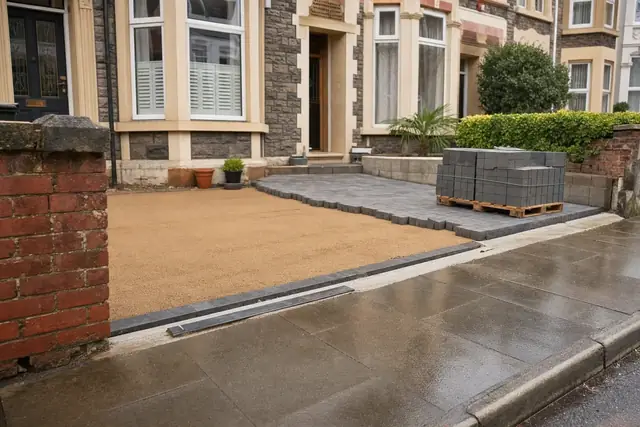
Do I Need Planning Permission for a Driveway in Wales?
Most driveways in Wales need no planning permission at all, as long as you get the surface and the drainage right. Here is how the five square metre rule, soakaways and dropped kerbs actually work in Cardiff.
Read the guide
Ready to transform your driveway?
Free quotes, a 25-year guarantee, and a team that turns up when they say they will.