
How Do I Prepare for a New Driveway Installation?
A practical checklist for the days before, during and after the crew arrives. The same steps apply to a new patio.
A new driveway is one of the messier jobs to have done at your home. For a few days, you will have a digger out front, a skip by the kerb, lorries bringing in stone and a crew needing clear access. A bit of preparation from you helps the job run quicker, cleaner and cheaper, and gives the finished surface the best start.
This guide takes you from the first site visit through to the first few weeks after the crew has left, and the same advice applies to a new patio. At Driveways and Paving Cardiff, we have been laying both across Cardiff, Barry, Caerphilly, Penarth and the Vale of Glamorgan since 1990. For answers that fit your own house, book a free no-obligation site visit by calling 07494 065997 or using the quote form.
What happens before the team arrives?
Before lifting a single block, a decent installer should have been out to visit, measured up, checked the ground and drainage, agreed a written quote and start date, and told you exactly what they need from you. First thing on the first morning, there should be a quick walk round with the crew before any tools come off the van.
Every job starts with a site visit, for block paving, resin, tarmac or a new patio. We measure up, see how water runs off the area now, check where the drains and inspection covers sit, and get a feel for the ground. A lot of the ground around Cardiff and the Vale is clay, which shrinks in dry summers and swells in wet winters, so the depth of dig and the sub-base matter more here than the surface you choose. You then get a written quote setting out the surface, the excavation depth, the edgings, the drainage and the price.
Once you give us the go ahead, we’ll give you a start date, a rough number of days we’ll be on site, and a clear list of what we need from you: where the skip can go, where materials can be dropped, and if we can use an outside tap and a 240 volt socket. The outside tap is important because wet cutting keeps the dust down, and it’s best to agree toilet use at the same time so nobody has to ask on the day.
Point the crew to any buried services before the digger goes in: the stopcock, gas meter, inspection chambers and drainage channels, plus any paperwork from previous utility work. We also check for underground services before the groundwork starts, as hitting a cable or gas pipe is dangerous and expensive.
You do not need to watch the job all week, but make sure you are there for the walk round on the first morning. That is when we confirm the levels, edging lines and the position of any recessed manhole tray. It is far cheaper to change your mind at that point than after the sub-base has been compacted. Once that is done, a phone number is enough. If you are still comparing installers, our guide on choosing a good driveway company covers quotes, deposits and guarantees.
What do I need to move or clear before installation day?
Clear the whole work area the evening before. Move every vehicle off the drive and away from the street frontage, shift bins, pots, furniture and toys, unlock side gates, and cut back any overhanging hedge or branch so lorries and machines can get in.
Start with the cars. Get them off the drive and, if you can, off the road straight outside the house, as that is where the skip, grab lorry and deliveries will need to sit. If you live on a busy street, sort out where they are going for the week now, not at seven o’clock on the first morning.
Clear the surface and the edges next: wheelie bins, recycling boxes, pots, garden furniture, bikes and ornaments all need moving to the back garden or the garage. Shift anything fragile stored just inside the garage door as well, because the breaker and the whacker plate send vibration through the slab.
Cut back anything hanging over the boundary. If a hedge brushes a car roof, it will catch a tipper lorry too, and the crew cannot cut your neighbour’s shrubs for you. Unlock side gates and make sure the side path is clear of bikes, bins and hoses, as that is the barrow route if machinery cannot get through.
While the job is under way, gates often get left open, so keep dogs and small children indoors, redirect parcel deliveries, and make sure the bin crew can still get to your bins. Expect dust in summer and mud in winter, and keep the front windows closed on digging days.

Where will the skip, materials and the crew park?
The skip and pallets will sit on your own drive or hardstanding, wherever there is space, because putting a skip on a public road, pavement or verge means getting a council permit. Our vans park on the street, and you will not be able to use the drive yourself until the job is finished.
A skip kept fully on your own property does not need a permit. If any part of it sits on the road, pavement or verge, you will normally need a council skip permit, and putting one there without permission can lead to a fine. Fees and lead times differ from council to council, so check Cardiff Council's current charge; the skip company usually applies on your behalf and passes the fee on, and we can include it in the quote.
For a typical two car drive, we often bring in a grab lorry instead. Digging out the whole area to around 200mm or more creates a surprising amount of spoil, and loose clay bulks up once it comes out of the ground. A grab lorry takes roughly twice the load of a six yard skip in one visit, so it is usually cheaper and tidier once there is more than a few cubic metres to shift, but it does need to stand within reach of the spoil heap.
Machine access decides how much disruption you will have that week. A micro digger under about 900mm wide will go through a standard garden gate, and the narrowest models can pull their tracks in tighter for the squeeze. If there is no side access, we either lift out a fence panel, crane the machine over, or barrow every load by hand, and we will tell you which one applies at the site visit. Vans park on the street, so let the crew know if your road has permit parking.
Do I need to tell my neighbours or the council?
Let your neighbours know a week or so before the work starts, just as a courtesy. Speak to the council well ahead of the start date if you need a dropped kerb, a skip on the road, or planning consent for a front drive that will not drain within your own boundary. In Wales, most like for like replacements need no application, but check your own case with your local council rather than assuming.
Speak to the neighbours first, it costs nothing and stops most of the grumbling before it starts. Give them the start date and the number of days to expect, let them know about deliveries, noise and dust, and point out anything that could affect shared access or on-street parking. Councils, including Cardiff, generally expect noisy building work to be kept to weekday daytime hours and Saturday mornings, and we work within those hours as a matter of course.
For planning in Wales, the short answer is this: a front driveway over 5 square metres is still permitted development if the surface is permeable, or if it drains to a lawn, border or soakaway within your own boundary. If an impermeable surface sends water onto the road, you need to apply for permission, and bigger jobs can also need separate sustainable drainage approval. The rules are different from England’s, and councils apply them locally, so speak to your council before you settle on a surface. Our guide on planning permission for a driveway in Wales covers the 5 square metre rule, SuDS, conservation areas and dropped kerbs in detail.
The dropped kerb is the bit to get moving early. If you are turning a front garden into a drive or widening the entrance, the council must approve the vehicle crossing first, the decision often takes weeks, and the work is usually carried out by the council’s contractor at your cost. Apply as soon as you have a quote, because it is the one part of the job where you do not control the timing.
How long does a new driveway take to install, and when can I use it?
As a rough guide, a two car drive takes one to two days in tarmac or resin, two to four days in imprinted concrete, and three to five days in block paving. You can usually walk on the new surface within a day or two, and park on it within three to seven days, depending on the finish and the weather.
The sequence stays much the same whatever surface is going in. Day one means marking out, breaking up the old surface, and digging down to the right depth. After that we set the drainage and levels, lay the MOT Type 1 sub-base and compact it in layers, then bed the edgings in concrete. The new surface only goes down once that is done, followed by cutting in, jointing or sealing, and a final sweep. The first two days are the loudest, with the breaker, digger and whacker plate all running.
Block paving takes the longest out of the common driveway surfaces, as each block has to be laid and cut by hand. A two car drive usually takes three to five days, and longer if the pattern is complicated or the area is large. Tarmac and resin bound can be laid in a day or two, but resin over a new base needs two visits, as a fresh tarmac base usually needs a couple of weeks to cure before the resin will bond to it. Pattern imprinted concrete is usually two to four days, while gravel can be used as soon as the crew leaves.
Curing is the bit where patience pays. With block paving, the edging concrete and jointing sand need a few days to firm up, so foot traffic is fine after a day or two, but we ask for three to seven days before parking. Resin bound can be walked on after about a day and will typically take a car after 48 to 72 hours, longer in cold or shaded spots. Tarmac takes foot traffic within a few hours, but needs at least three days before anything drives on it, longer in hot weather, and imprinted concrete needs around five to seven days.
Patios work much the same way. The mortar bed needs a day or two to set before the joints are filled, the jointing compound can be walked on after about a day and will take furniture after a few days to a week, with everything taking longer in a wet Welsh autumn. Guide prices for each surface are on our driveway cost page, and a free written quote fixes the figure for your drive.
| Surface | Typical install time | Walk on | Drive on | Worth knowing |
|---|---|---|---|---|
| Block paving | 3 to 5 days | 24 to 48 hours | 3 to 7 days | Edge concrete and joints need time to lock up |
| Resin bound | 1 to 2 days on a ready base | About 24 hours | 48 to 72 hours | A new tarmac base needs about 2 weeks first |
| Tarmac | 1 to 2 days | A few hours | 3 days, longer in hot weather | Keeps hardening for months |
| Pattern imprinted concrete | 2 to 4 days | 24 to 48 hours | 5 to 7 days | Sealed at about 28 days |
| Gravel | 1 to 3 days | Straight away | Straight away | Settles under the first few cars |
| Stone or porcelain patio | 3 to 5 days | About 24 hours after jointing | Not for vehicles | Joints take furniture after a few days |

What weather delays a driveway or patio, and what happens then?
Rain and frost are the two things that hold up a driveway job. Resin cannot be laid in the wet at all, tarmac and concrete need a dry day well above freezing, and block paving can carry on in light rain. If a day gets postponed, it is the sign of a careful installer, not a slow one.
South Wales takes plenty of Atlantic rain, so the weather has to be built into the programme for a drive here. Resin bound is the most weather-sensitive surface we lay. It needs a dry base, dry air and a mild temperature, roughly 5 to 35 degrees under most manufacturers' guidance, and rain on uncured resin can leave white patches and spoil the finish. This is the surface most likely to be delayed at short notice, so be wary of anyone offering to lay resin in drizzle.
Hot laid tarmac needs a mild day, ideally 10 degrees or above. If the mix gets cold, it stiffens before it can be compacted properly and is more likely to crack later. It should never be laid on frozen ground or in rain. Concrete and mortar follow the usual rule of 3 degrees and rising. Imprinted concrete should not be poured when showers are forecast, as rain spoils the imprint.
Block paving is the forgiving option. We can carry on in light rain, provided the laying sand has not become saturated. Heavy rain turns the bed to porridge, and kiln dried jointing sand cannot be brushed in until the surface is bone dry, so if the last day is wet, we may need a quick return visit to finish the joints. Hard frost stops nearly everything apart from digging and drainage.
If we lose a day, the crew looks after the work already done: the sub-base is left to drain, edging concrete is covered, pallets are sheeted, and we carry on at the next dry day. Spring and early autumn are best for tarmac and resin, while block paving and patios can be laid for most of the year. Our quote fixes the price, not the date, and we would rather tell you tomorrow is off than put down a surface that will not last.
How do I look after a new driveway in the first few weeks?
Keep heavy vehicles, skips and anything with a narrow base off the surface. On new tarmac or resin, never turn the steering wheel while stationary. Once block paving joints settle, top them up with kiln dried sand, and leave sealing until the surface has properly weathered and dried out.
The first few weeks make a big difference and help protect the drive for years. Keep vans, caravans, trailers and anything heavier than a family car off it until well past the cure times above. Watch point loads as well, skips, planters on narrow legs, ladder feet, motorbike stands and car jacks all press hard on one small area, so put a board underneath. Move where you park, and after the first heavy rain, tell the installer if water is standing anywhere.
Tarmac needs the most looking after early on. Dry steering, turning the wheel while the car is stationary, leaves circular scuff marks, worst in the first months and on hot, south facing drives where the bitumen softens. Petrol, diesel, oil and power steering fluid dissolve the binder and pit the surface, so mop up spills straight away. Light scuffs usually weather out during the first year.
With block paving, the jointing sand will settle over the first few weeks. Top the joints up with kiln dried sand on a completely dry day, brush it in with a soft broom, then do the same again a few weeks later. If you see a white powdery bloom on new blocks, that is efflorescence. It clears by itself, and it is one reason our block paving guide says to leave a new block paved drive unsealed for at least six months. For resin bound, do not jet wash, scrub or use chemical cleaners in the first days. Avoid dry steering in the first week, and wipe up spills as soon as you see them.
Imprinted concrete can be walked on the next morning, but keep cars off it for five to seven days. We apply the sealer at about 28 days, once there are no damp patches, as sealing over trapped moisture turns it milky. In the first winter, use grit rather than rock salt on any new surface. Cleaning, moss and winter care beyond the first weeks are covered in our guide on why a driveway sinks or cracks. Every drive and patio we lay carries our 25 year guarantee, so if anything looks wrong in those first weeks, call us and we will come and look.
| Surface | Do | Do not | Normal at first | Call us if |
|---|---|---|---|---|
| Block paving | Top up joints with kiln dried sand on a dry day | Seal in the first 6 months or jet wash early | White efflorescence bloom | Blocks rock or joints stay open |
| Resin bound | Vary parking and wipe spills at once | Jet wash, dry steer or use harsh cleaners | Slight sheen that dulls | Loose stone or bare patches |
| Tarmac | Board under jacks, stands and bins | Dry steer, park heavy vans or place a skip | Light scuffs in warm weather | Deep marks or a soft area |
| Pattern imprinted concrete | Keep clean and dry until sealing at about 28 days | Drive on it for 5 to 7 days or seal over damp | Colour evening out as it dries | Cracks away from the control joints |
| Gravel | Rake stone back and keep edges tidy | Spin wheels or pile stone too deep | Slight settling under the first cars | Ruts under regular tyre lines |
| Patio | Leave joints 24 hours before walking on them | Drag furniture or jet wash fresh joints | Joints darkening as they cure | Slabs that rock or sound hollow |

Not sure if yours needs a repair or a full replacement?
Book a free site visit and we will give you a straight answer, backed by our 25-year guarantee and 35 years working with Cardiff and South Wales ground conditions.
Book a free site visit Call 07494 065997Frequently asked questions
Do I need to be at home while my driveway is being installed?
No need to be there for the whole job. Be in for the walk round on the first morning, when we agree the levels and edge lines, then stay on the end of the phone. You will not be able to park on the drive until it has cured, but the crew will keep a safe route to your front door throughout.
What happens to the manhole cover in my driveway?
We normally swap it for a recessed tray cover, so the new surface runs over the top and the pattern stays unbroken. Domestic trays are rated for cars and light vans, the infill is cut to match the surrounding drive, and the chamber stays accessible for rodding.
Can a mini digger get down the side of my house?
Usually, yes, if the gap is around 900mm or more and clear of pipes and meters. The narrowest micro diggers pull their tracks in to get through, then widen them again once they are on the job. If there is no side access, the crew can lift out a fence panel, crane the machine over, or barrow everything through.
When can I put a caravan or trailer on my new drive?
Give it much longer than the usual car timings. A caravan or trailer bears down through the jockey wheel and corner steadies, which is exactly the sort of point loading a fresh surface does not like. Leave it a few weeks on block paving, resin or concrete, keep it off new tarmac through the first warm months, and always put boards under the wheel and steadies.
More guides you might find useful
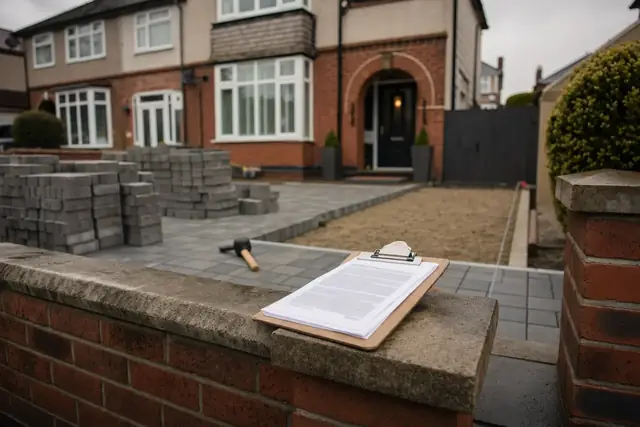
How Do I Choose a Good Driveway Company?
Getting a driveway done is easy. Getting it done properly comes down to who you hire. Here is how to choose well, from the first questions you ask to the guarantee you should expect in writing.
Read the guide
Do I Need Planning Permission for a Retaining Wall in Wales?
Most advice on retaining walls quotes English rules. Here is the Welsh guidance, the Highways Act control for walls near the street, when you need an engineer, why walls bulge, what they cost and who is responsible when a wall sits between two gardens.
Read the guide
Why Does My Driveway Flood Every Time It Rains?
Met Office averages put Cardiff at roughly 1,200 mm of rain a year, and the wettest months are exactly when drives flood. Here is how we diagnose standing water on site, the fall a drive should have, why soakaways struggle on local clay, what Wales requires, and what a fix costs.
Read the guide
Ready to transform your driveway?
Free quotes, a 25-year guarantee, and a team that turns up when they say they will.